Shopper Marketing
What Is Shopper Marketing? A Complete Guide for FMCG Brands
Shopper marketing connects consumer attention to actual purchases — not just awareness. A complete guide to what it means, why it matters for FMCG brands, and how it is evolving from offline retail to digital commerce.
For decades, FMCG marketing has focused on building brand awareness, increasing reach and creating consumer preference.
Brands invest heavily in television advertising, digital campaigns, influencer marketing, outdoor media and in-store promotions to influence consumer decisions.
But there is an important question:
How much of that consumer attention actually translates into product purchases?
A consumer may see an advertisement on Instagram, discover a product through an influencer, browse it on a quick commerce platform or notice an offer at a neighbourhood grocery store. Yet connecting these interactions to an actual purchase remains a challenge for many FMCG brands.
This is where shopper marketing plays an important role.
What Is Shopper Marketing?
Shopper marketing is the practice of influencing consumers throughout their shopping journey — from product discovery and consideration to purchase and repeat buying.
Unlike traditional brand advertising, which primarily focuses on awareness and brand perception, shopper marketing focuses on influencing the purchase decision.
It connects marketing activities with shopping behaviour and helps brands convert consumer interest into measurable sales outcomes.
For FMCG brands, this means reaching shoppers at the right moment, through the right channel, with the right offer or incentive.
Why Is Shopper Marketing Important for FMCG Brands?
FMCG brands operate in a highly competitive environment. Consumers have multiple product choices, competing brands and changing shopping preferences.
Shopper marketing helps brands address some of the most important business challenges.
1. Drive Product Trials and New Product Adoption
Launching a new product is only the first step. Getting consumers to try it is often the bigger challenge.
Brands can use product sampling, introductory discounts, digital coupons and cashback incentives to encourage first-time purchases.
These campaigns can help reduce the barrier to trying a new product.
2. Increase Basket Size
Shopper marketing can encourage consumers to purchase larger packs, combination packs or complementary products.
For example:
- Buy two packs and receive cashback.
- Purchase a family pack and get an additional discount.
- Buy a combination of products and unlock a promotional reward.
Such offers can encourage higher-value transactions while giving shoppers a tangible benefit.
3. Influence Purchase Decisions at the Point of Sale
A shopper's decision is often influenced close to the moment of purchase.
Digital flyers, in-store promotions, QR codes, product displays and retailer recommendations can help brands influence these decisions.
This is particularly relevant in neighbourhood grocery stores and traditional retail environments.
4. Improve Repeat Purchases and Customer Loyalty
Shopper marketing does not end with the first transaction.
Brands can use loyalty programmes, targeted offers, milestone rewards and repeat-purchase incentives to encourage consumers to buy again.
The objective is to build stronger relationships between brands, retailers and shoppers.
The Evolution of Shopper Marketing: From Offline Retail to Digital Commerce
Traditionally, shopper marketing was largely associated with in-store promotions, product displays, trade schemes and retailer incentives.
However, shopping behaviour has changed significantly.
Consumers now discover products across multiple channels:
- Social media and digital advertising.
- Influencer and creator content.
- Brand websites and digital campaigns.
- Quick commerce platforms.
- Supermarkets and neighbourhood grocery stores.
- Product packaging and QR codes.
This has created an opportunity for brands to connect digital discovery with actual shopping destinations.
Digital Media to Purchase
A consumer discovers a product through a digital advertisement, social media post or influencer campaign.
Instead of ending with a product impression or website visit, the campaign can guide the shopper to a relevant shopping destination.
Quick Commerce Activation
Platforms such as Swiggy Instamart and Zepto have made product discovery and purchasing increasingly convenient.
Brands can connect digital campaigns with relevant product or shopping links on supported quick commerce platforms, helping reduce the distance between discovery and purchase.
QR Code-Based Shopper Engagement
QR codes on packaging, promotional material and in-store displays can connect shoppers to product information, offers, digital coupons and shopping destinations.
A physical interaction can become the starting point of a digital shopper journey.
Offline Retail Media
Neighbourhood stores and supermarkets can become important shopper engagement channels.
Digital store pages, promotional QR codes, retailer-led offers and WhatsApp communication can help brands connect with shoppers closer to the point of purchase.
The Role of Brand-funded Offers and Cashback
Promotional incentives are an important part of shopper marketing.
Instead of relying only on price discounts, brands can fund targeted offers to encourage specific consumer behaviours.
Examples include:
- Cashback on first-time purchases.
- Buy-more-save-more promotions.
- Incentives for purchasing larger packs.
- Combination offers across multiple products.
- Rewards for repeat purchases.
- Promotional incentives for new product launches.
When supported by appropriate transaction validation, these campaigns can help brands understand which offers resulted in actual purchases.
Why Purchase Measurement Matters
One of the biggest challenges in FMCG marketing is connecting campaign engagement with actual sales.
Traditional digital campaigns provide metrics such as impressions, clicks, reach and engagement. These are useful, but they do not necessarily establish whether a product was purchased.
Shopper marketing can become significantly more effective when campaigns are connected to purchase data.
Depending on available integrations, brands can use POS billing data, SKU-level transaction information, receipt verification and offer redemption records to understand campaign outcomes.
This helps answer important questions:
- How many shoppers purchased the promoted product?
- Which pack sizes performed better?
- Did cashback encourage larger baskets?
- Which offers generated product trials?
- Which campaigns encouraged repeat purchases?
The goal is to move beyond measuring attention towards understanding purchase behaviour.
The Future of Shopper Marketing
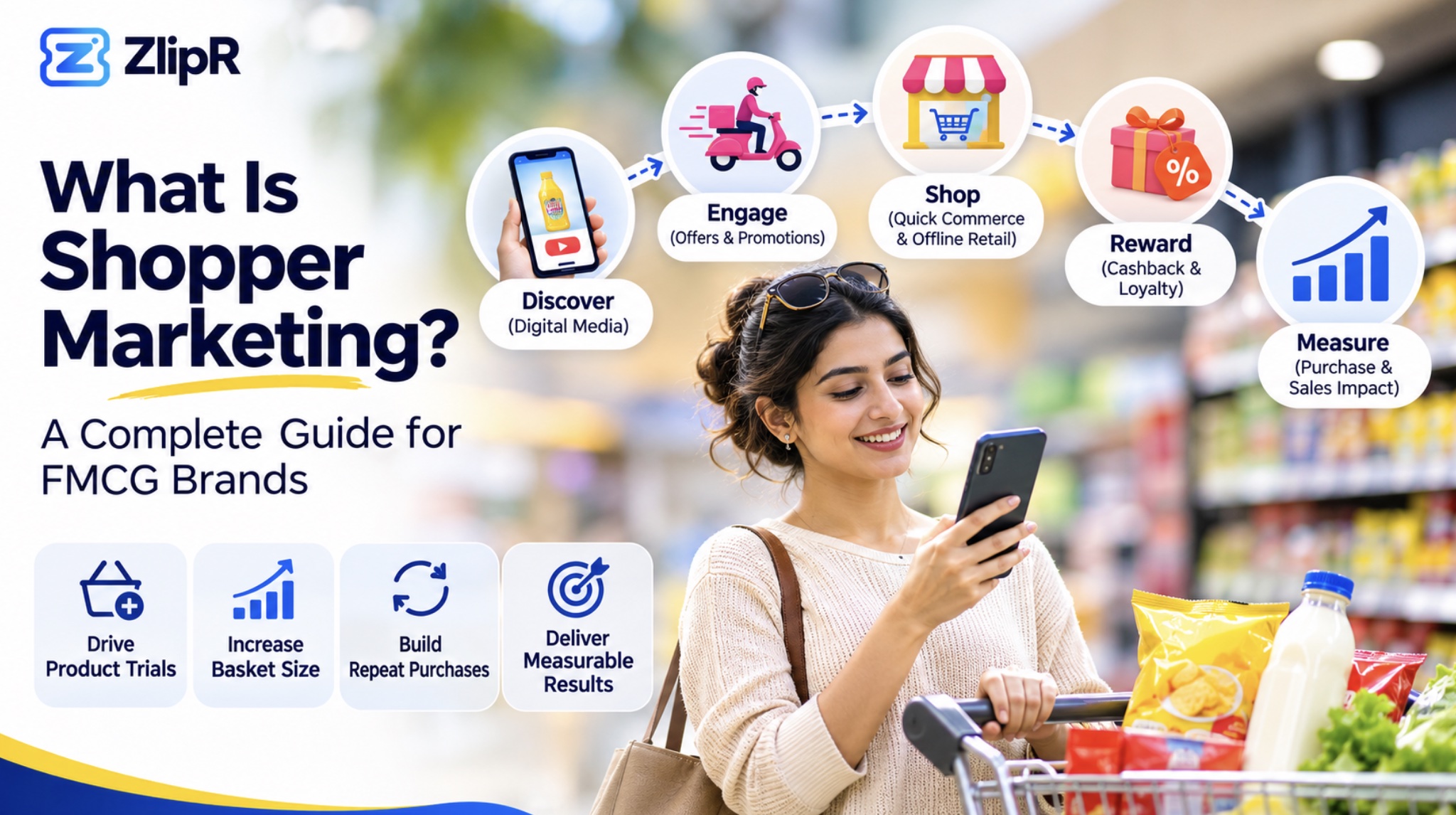
The future of shopper marketing will be shaped by the convergence of five areas:
- Digital Media: Discover and engage consumers across digital channels.
- Quick Commerce: Connect product discovery with convenient shopping destinations.
- Offline Retail: Activate neighbourhood stores and physical retail networks.
- Brand-funded Offers: Incentivise product trials, larger baskets and repeat purchases.
- Purchase Measurement: Connect campaign activity with validated purchase outcomes wherever transaction data is available.
These capabilities can create a more connected shopper journey:
Discover → Engage → Shop → Reward → Measure
How ZlipR Is Enabling Shopper Marketing
At ZlipR, we believe the next evolution of FMCG marketing is about connecting consumer attention with measurable purchase action.
ZlipR is a Shopper Marketing & Commerce Activation Platform that helps FMCG and D2C brands connect digital campaigns, quick commerce, offline retail and brand-funded promotions.
The platform brings together:
- Digital campaign-to-commerce activation.
- Retail media and in-store shopper engagement.
- QR-based campaigns and shoppable experiences.
- Brand-funded cashback and promotional offers.
- POS integrations and purchase measurement.
By connecting these capabilities, brands can create more meaningful shopper interactions and better understand how marketing initiatives influence purchases.
Because ultimately, the real impact of marketing is not just what consumers see. It is what they choose to buy.
Explore ZlipR’s Shopper Marketing solution.