Commerce Activation
What Is Commerce Activation? Turning Consumer Attention into Measurable Purchases
Commerce activation connects digital advertising, quick commerce, offline retail and brand-funded offers into one measurable shopper journey — turning consumer attention into actual purchases.
Every day, consumers discover thousands of products through digital advertisements, social media, influencer content, quick commerce platforms and physical retail stores.
FMCG brands invest significantly in generating this attention. But an important question remains:
How do brands turn consumer attention into actual product purchases?
A digital advertisement may generate millions of impressions. An influencer campaign may create significant engagement. A product promotion may attract shoppers to a retail store.
But how effectively are these interactions translating into shopping actions, product trials and sales?
This is where Commerce Activation comes in.
Commerce activation focuses on connecting marketing activities with shopping opportunities and purchase decisions. It helps brands move beyond generating awareness to actively influencing what consumers discover, consider and ultimately buy.
For FMCG and D2C brands, it represents an opportunity to bring marketing, digital commerce, retail activation and promotional incentives into one connected shopper journey.
What Is Commerce Activation?
Commerce activation is the process of converting consumer interest and marketing engagement into actionable shopping opportunities and purchases.
It connects different stages of the consumer journey:
- Product discovery through digital advertising and content.
- Shopper engagement through campaigns and interactive experiences.
- Product consideration through offers, promotions and recommendations.
- Purchase through online platforms and offline retail.
- Rewards through cashback, coupons and loyalty incentives.
- Measurement through available transaction and redemption data.
Unlike traditional marketing campaigns that primarily focus on reach, impressions and engagement, commerce activation places greater emphasis on influencing shopping behaviour.
The objective is simple:
Don't just create awareness. Create a reason and an opportunity to purchase.
Why Is Commerce Activation Important for FMCG Brands?
Consumer shopping behaviour has become increasingly fragmented.
A shopper might discover a new product on Instagram, watch an influencer demonstrate it, search for it on a quick commerce app and eventually purchase it from a neighbourhood grocery store.
The journey between product discovery and purchase can involve multiple platforms and touchpoints.
This creates several challenges for FMCG brands.
1. The Gap Between Advertising and Purchase
Digital advertising platforms provide extensive campaign metrics, including impressions, clicks, video views and engagement.
However, these metrics do not always establish whether the promoted product was purchased.
Brands need ways to connect advertising campaigns with relevant shopping destinations and available purchase information.
2. Fragmented Shopping Channels
Consumers shop across e-commerce, quick commerce, supermarkets and traditional retail.
A brand may run separate campaigns across these channels, making it difficult to create a consistent shopper experience.
Commerce activation helps connect these different environments.
3. Driving Product Trials
New product launches and new variants require more than awareness.
Consumers need a reason to try something unfamiliar.
Digital coupons, introductory discounts, cashback and product sampling incentives can help motivate first-time purchases.
4. Increasing Basket Size
FMCG brands often want to encourage consumers to purchase larger packs, multiple units or complementary products.
Traditional single-product discounts may not always achieve this objective.
Combination offers, multipack promotions and buy-more-save-more campaigns can encourage shoppers to purchase more during a transaction.
5. Measuring Promotional Outcomes
Brands need to understand whether their marketing investments are influencing actual shopping behaviour.
Connecting promotional campaigns with POS data, receipt verification and available digital commerce transaction information can provide greater visibility into eligible purchases and offer redemptions.
The Four Pillars of Commerce Activation
An effective commerce activation strategy connects four important capabilities.
1. Digital Commerce: Turning Digital Attention into Shopping Actions
Consumers discover products across search engines, social media, digital advertisements, influencer campaigns and brand websites.
But the journey should not end with a click or product view.
Digital commerce activation connects these marketing touchpoints with relevant shopping destinations.
For example:
A consumer sees an advertisement for a new snack product on Instagram. Instead of simply visiting a generic brand website, the campaign takes the consumer to a product-specific shopping experience with a link to a supported quick commerce platform.
This reduces the gap between product discovery and purchase.
Key opportunities include:
- Ad-to-Cart campaigns.
- Shoppable brand pages.
- Creator and influencer-led shopping.
- Product-specific campaign links.
- Quick commerce activation.
- Product bundles and combination offers.
Platforms such as Swiggy Instamart and Zepto provide relevant shopping destinations for supported product links and campaigns.
2. Offline Retail Media: Bringing Digital Activation into Physical Stores
A significant part of everyday FMCG shopping continues to happen through physical retail outlets.
Neighbourhood Kirana stores, supermarkets and modern trade outlets offer valuable opportunities to engage consumers closer to the point of purchase.
However, many traditional retail promotions still depend on printed posters, physical displays and word-of-mouth communication.
Commerce activation can help connect these physical touchpoints with digital experiences.
Examples include:
- Digital flyers and promotional catalogues.
- QR codes on in-store displays.
- Digital retailer storefronts.
- Local and brand advertising.
- WhatsApp-based promotional communication.
- Store-specific offers and promotions.
This creates opportunities for brands to activate participating retailers as local shopper engagement and media channels.
3. Brand-funded Offers: Giving Shoppers a Reason to Buy
Advertising creates awareness, but promotional incentives can provide an additional reason to purchase.
Brand-funded offers allow FMCG companies to reward eligible purchases through targeted promotional campaigns. Some examples include:
- Product trial incentives — offer cashback on the first purchase of a new product or variant.
- Larger pack promotions — encourage consumers to choose a family pack or larger SKU through a promotional reward.
- Combination offers — reward shoppers for purchasing complementary products together.
- Buy-more-save-more campaigns — provide incentives when shoppers purchase multiple units.
- Repeat-purchase campaigns — encourage consumers to purchase the product again through milestone rewards or targeted offers.
These promotional mechanics can be activated across digital campaigns, quick commerce and participating offline retail environments.
4. Purchase Measurement: Connecting Engagement with Actual Purchases
The final and perhaps most important pillar is measurement.
Brands need to understand what happens after a shopper interacts with a campaign.
Commerce activation becomes more valuable when marketing activity can be connected with available purchase information.
Depending on the integrations and data sources available, this can include:
- Campaign engagement and QR scans.
- Product-specific shopping actions.
- POS billing and SKU-level transaction data.
- Receipt and invoice verification.
- Eligible cashback and coupon redemptions.
- Campaign-level promotional expenditure.
- Repeat-purchase activity where identifiable.
This helps brands move beyond measuring attention and towards understanding purchase outcomes.
How Commerce Activation Works: An Example
Consider an FMCG brand launching a new family-sized pack of breakfast cereal.
The brand wants to increase product trials and encourage consumers to choose the larger pack.
A connected commerce activation campaign could work as follows:
- Create Awareness — the brand launches digital advertisements and influencer campaigns highlighting the new family pack.
- Connect to Shopping — campaign links direct interested shoppers to relevant product pages on supported quick commerce platforms.
- Activate Offline Retail — participating supermarkets and neighbourhood stores display promotional QR codes and digital flyers highlighting the new product.
- Incentivise Purchases — the brand offers cashback on eligible purchases of the family pack or a combination of selected products.
- Validate Purchases — available POS transaction data or receipt-verification mechanisms are used to check campaign eligibility.
- Measure Outcomes — the brand reviews campaign engagement, eligible purchases, approved cashback redemptions and promotional expenditure.
Instead of running disconnected advertising and trade promotion activities, the brand creates a more connected journey from discovery to purchase.
Commerce Activation vs Traditional Marketing
Traditional marketing and commerce activation serve different but complementary purposes.
| Traditional marketing | Commerce activation |
|---|---|
| Focuses on awareness and reach | Connects awareness with shopping actions |
| Measures impressions and engagement | Also tracks available purchase outcomes |
| Promotes brand messages | Promotes products and purchase opportunities |
| Runs channel-specific campaigns | Connects digital and physical touchpoints |
| Builds brand preference | Encourages trials, basket growth and repeat purchases |
Commerce activation does not replace brand advertising. It complements it by creating a stronger connection between marketing investments and retail outcomes.
How ZlipR Is Enabling Commerce Activation
At ZlipR, we believe the next evolution of FMCG marketing lies in connecting consumer attention with measurable purchase action.
ZlipR is a Shopper Marketing & Commerce Activation Platform designed to connect brands, retailers and shoppers across digital and physical commerce environments.
The platform brings together four connected capabilities.
Digital Commerce
Connect digital advertisements, social media, creator campaigns and brand content with shoppable experiences and supported quick commerce destinations.
Offline Retail Media
Activate participating neighbourhood stores, supermarkets and retail networks through digital flyers, QR campaigns, in-store promotions and local advertising.
Brand-funded Offers
Create targeted cashback, digital coupon and promotional campaigns to encourage product trials, larger baskets and repeat purchases.
Purchase Measurement
Connect campaigns with POS integrations, UPC/SKU-level purchase validation, receipt verification and redemption reporting wherever the required data and integrations are available.
Together, these capabilities help brands create a connected shopper journey:
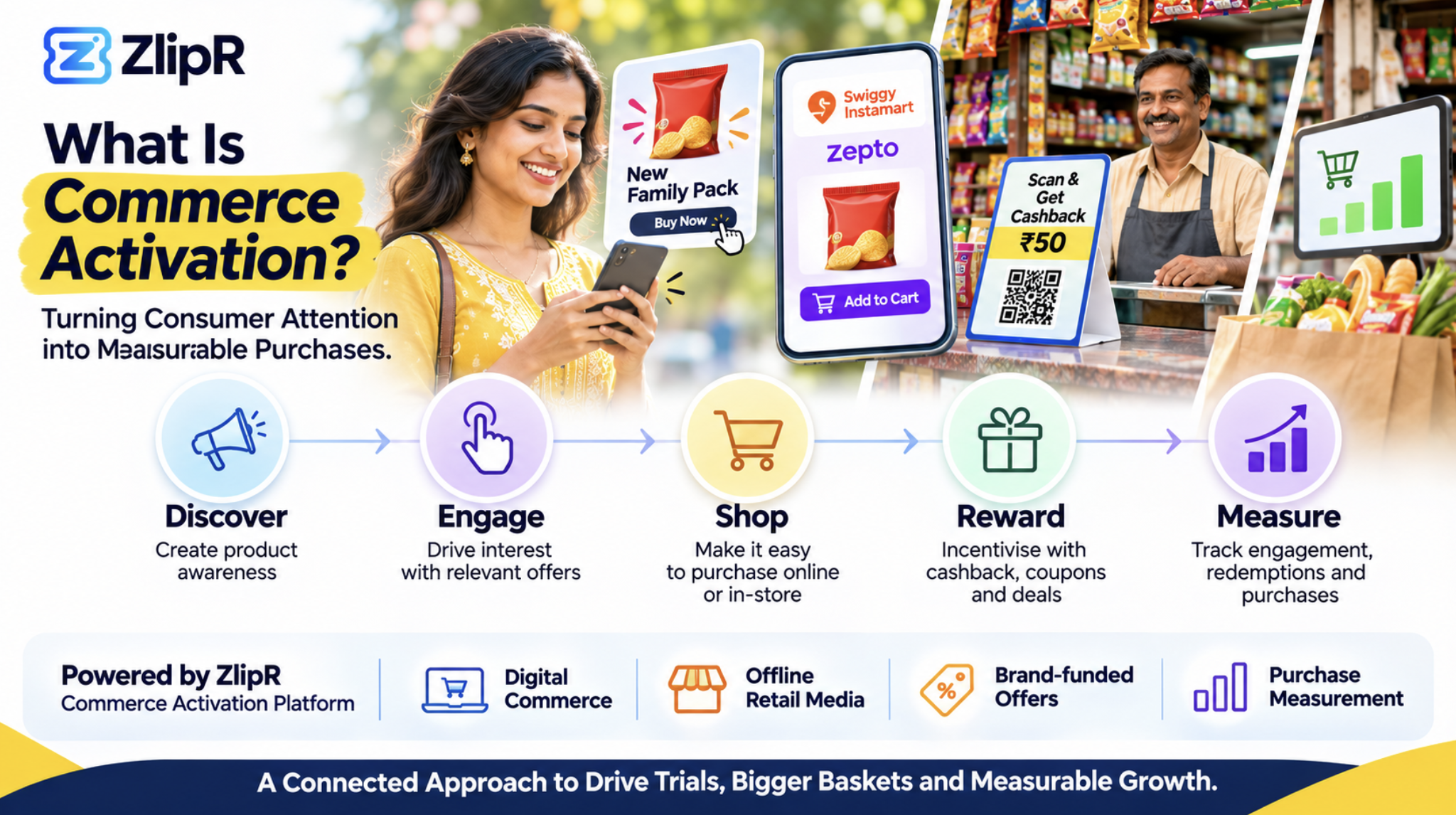
Discover → Engage → Shop → Reward → Measure
The objective is to bring different marketing and commerce touchpoints together rather than manage them as isolated campaigns.
The Future of FMCG Marketing Is Commerce-led
The boundaries between advertising, shopper marketing, retail media and digital commerce are becoming increasingly connected.
Consumers do not think in terms of marketing channels. They discover products wherever they encounter them and purchase through whichever shopping option is convenient.
Brands therefore need to think beyond individual advertising campaigns and focus on the entire journey between consumer attention and purchase.
Commerce activation creates an opportunity to:
- Make digital campaigns more actionable.
- Connect online discovery with offline retail.
- Encourage product trials and larger baskets.
- Give shoppers meaningful promotional incentives.
- Improve visibility into campaign and purchase outcomes.
At ZlipR, we are building towards this connected future by bringing digital commerce, offline retail media, brand-funded promotions and purchase measurement together.
Because marketing should not stop at capturing attention. It should create opportunities to influence what shoppers actually buy.
Explore ZlipR.
Explore our solutions: